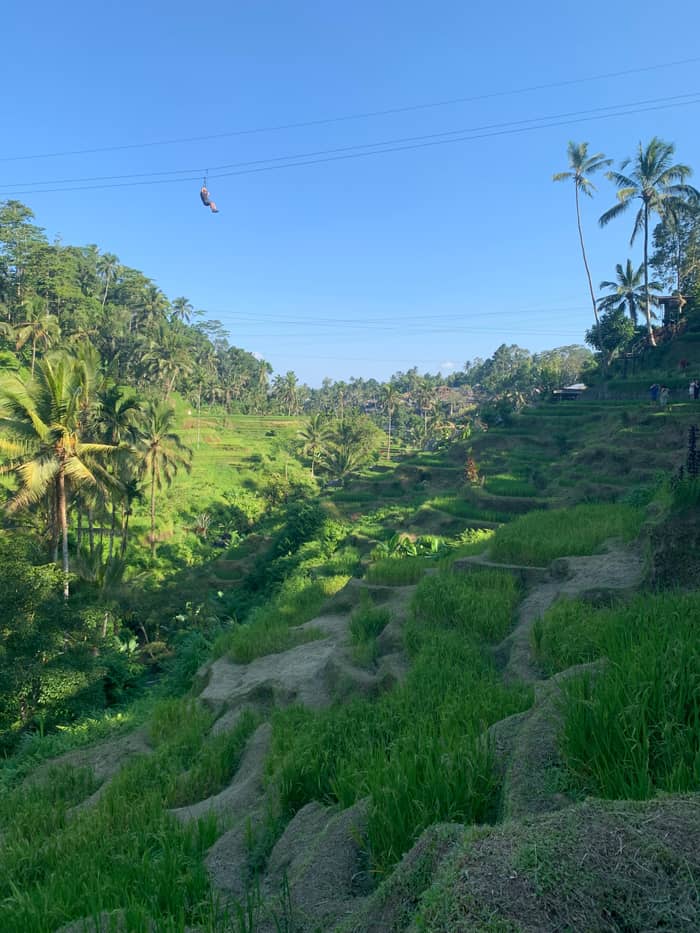
Our own full day
The full Ubud day
Forest is stop 1 of 7
- Time in forest60 minutes allotted
- Pricefrom $59
- Rating4.98
Locate the spot
Show all 17 Ubud stops on the map
Choose a map view, then press a pin or a place name for its note and a Google Maps link.
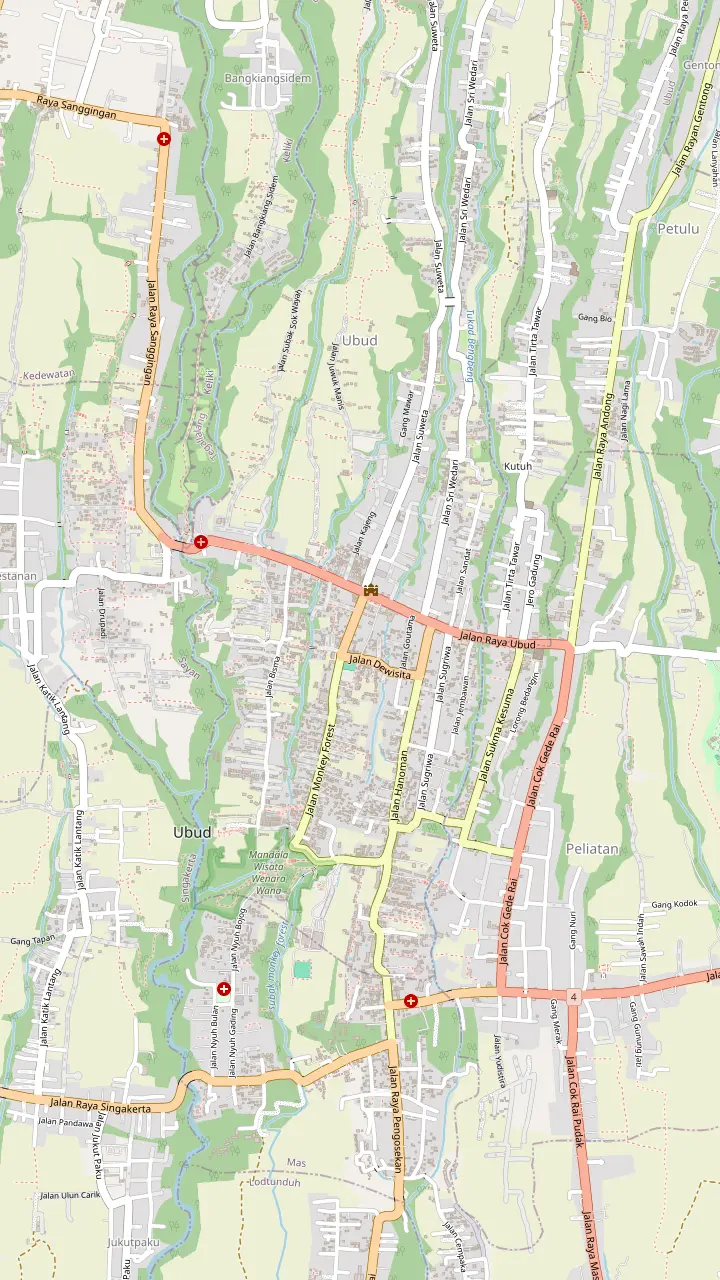
Open 9:00 AM to 6:00 PM, last entrance 5:00 PM, with an adult fee of IDR 130,000.
Google MapsThe official residence of the Ubud royal family, where traditional dance is often held in the courtyard at night.
Google MapsSells Balinese souvenirs, handicrafts, jewelry and clothing, and prices are often negotiable.
Google MapsKnown for the lotus pond at the front of the temple; listed as free, open 07.00 to 17.00 WITA.
Google MapsCalled the oldest art museum in Bali, established in 1956.
Google MapsA free path open 24 hours, about 15 to 20 minutes to the peak over 2 kilometers.
Google MapsA palace founded in the 17th century that often hosts Legong and gamelan.
Google Maps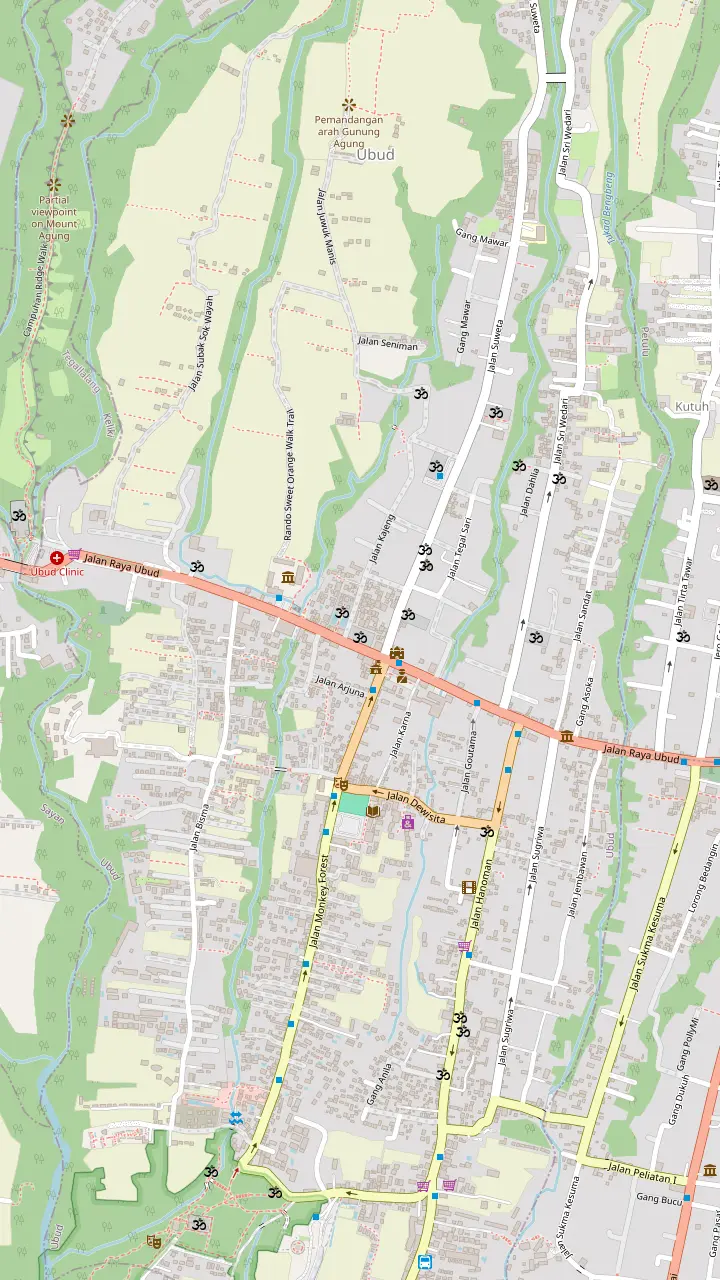
The Legong ticket listing gives 7:30 PM daily and about 90 minutes, and advises arriving 45 minutes early.
Google MapsThe ministry's palace page puts the evening admission at approximately Rp100,000 for the performances.
Google MapsIndonesia.Travel lists it on Jalan Kajeng in central Ubud.
Google MapsFounded by the King of Ubud with Rudolf Bonnet and Walter Spies to keep Balinese art from being sold abroad.
Google Maps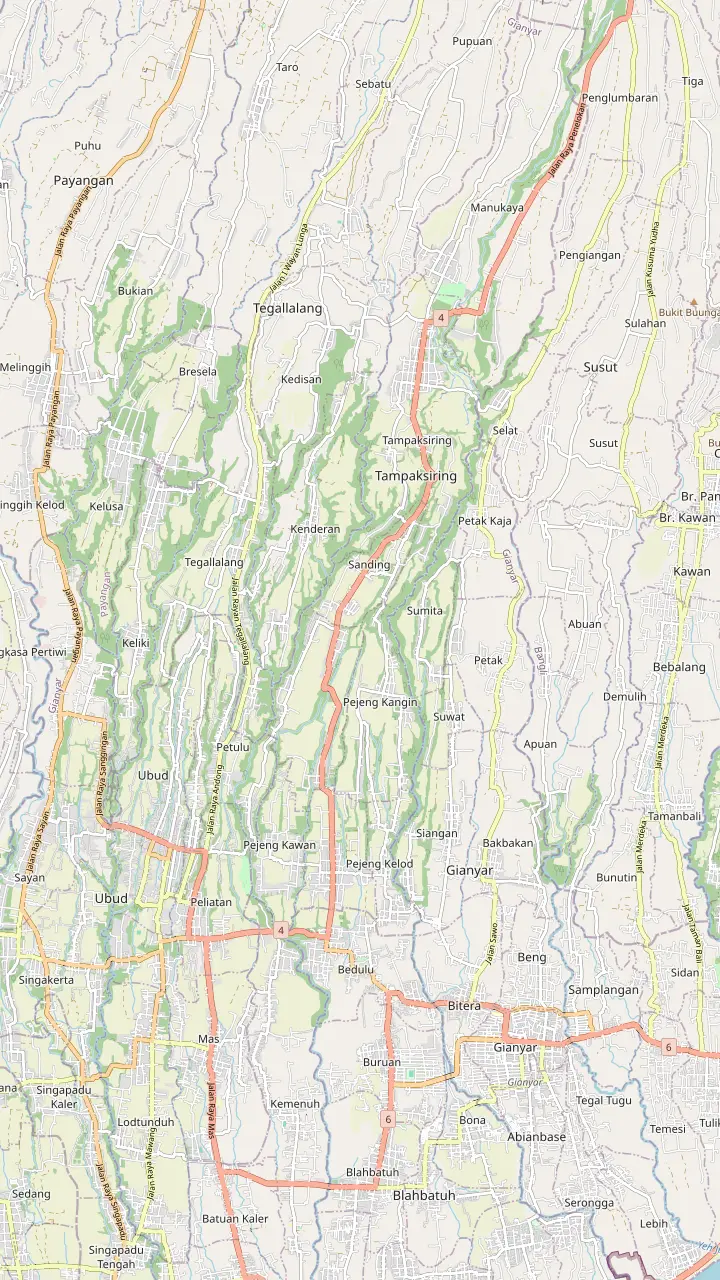
The terraces are a short 20-minute drive north of Ubud, or about two hours on foot.
Google MapsThousands of white herons return to the treetops every late afternoon; the village is open 06.00 to 19.00.
Google MapsExploring the terraces takes roughly 30 minutes to 1.5 hours.
Google MapsTo join the bathing ritual, wear traditional attire or a yellow sash and use no soap or shampoo.
Google MapsFour distinct complexes; a sarong and sash are essential and can be rented on site.
Google MapsA 15 meter waterfall the community considers sacred, used as a beji for holy-water ceremonies.
Google MapsMap drawn from OpenStreetMap data, © its contributors
The Ubud Monkey Forest is a nature reserve, a temple complex and a village asset in one. This guide reads its official pages for hours, tickets, house rules and the troops.
Editorial team, ubuddaytour.quest · Updated November 3, 2026 · Reading time: about 9 minutes
The short version of the day
The Sacred Monkey Forest Sanctuary stands on Jalan Monkey Forest in Padangtegal, in the middle of Ubud, and visitors enter through a lobby that handles ticketing and information.6 The sanctuary puts the forest at around 12.5 hectares.7 That is a small patch of land to cross on foot, yet it behaves like a full ecosystem, with banyan roots over the paths, moss on the statues and a canopy that cools the walkways.
Trees are part of the story. The sanctuary says it worked with Udayana University in Denpasar to identify 115 separate species of trees, while its visit page counts 186 species in the same forest.8,9 The two pages do not explain the gap. Read both numbers as a long list of tree species, and expect a dense canopy rather than a tidy park. Wide roots and hanging vines are the visual signature of the place, and they make the shaded paths feel old.
The forest is not an old, untouched block either. The sanctuary says a new forest was established in the 1990s to give the growing monkey population more space.10 When you walk the far edges you may be standing in that planted extension. The village treats the whole site as a spiritual, economic, educational and conservation center, a view the visit page states in its own words.11 Walk it slowly and you will notice the difference between mature trunks near the temples and younger growth at the edges.
Past the lobby
| Temple | Where | What it is for |
|---|---|---|
| Principal temple | Southwest | Worship of Shiva, the Transformer |
| Holy Spring (Beji) | Northwest | Purification before ceremonies; melukat |
| Prajapati | Northeast | Cremation temple beside the cemetery |
Positions and purposes are the sanctuary's own descriptions on its visit page; every one of them is for prayer only.19,20,4
Ask how many macaques live here and you get different answers, even from official pages. The sanctuary's FAQ says approximately 1,054 monkeys, divided into 7 groups named Cemetery, Central, Michelin, East, Temple, South and New Forest.2 Its home page says over 1054 long-tailed macaques, and its visit page says around 1,030.13,9 Those three sit close together, and a troop of this kind will never hold still at one number.
The tourism ministry's pages give very different figures. One Indonesia.Travel article says around 340 long-tailed macaques, and another says some 700.14,15 Neither gives a date or a counting method. The chart below sets the counts side by side so you can see the spread; quote the sanctuary's own 1,054, the figure that comes with a breakdown by group.2 Treat any figure as a snapshot of a moving population, because births and group movements change the picture from year to year.
The sanctuary also describes what the animals are: Macaca fascicularis, the Balinese long-tailed macaque.16 Females average 2.5 to 5.7 kg and males 3.5 to 8 kg.17 The sanctuary lists the species as Endangered, most recently assessed for the IUCN Red List in 2022.18 A conservation label sits oddly beside a tourist photo stop, yet the two coexist here every day. Watching a mother carry an infant along a wall makes the Red List label feel concrete.
Inside the forest there are 3 temples: Pura Dalem, the Holy Water Temple and the Cremation Temple.3 The main temple stands in the southwest, where people worship Hyang Widhi as Shiva.23 The visit page places the Holy Spring Temple, also called Beji, in the northwest, where it is frequently used for melukat, spiritual and physical cleansing.19 The pale stone, moss and statues that line the approach are worth a slow look even though you stay outside the gates.
The third temple, Prajapati, stands in the northeast next to the cemetery.24 The cemetery is used temporarily as a waiting place until the mass cremation that is held every 5 years.20 The sanctuary's culture page describes the cremation ceremony as Ngaben, and repeats the five-year rhythm.25 If you visit in a year when preparations are under way, expect villagers rather than tourists to be the main business of the day.
You cannot walk into any of them. The sanctuary's FAQ says the temples are only for prayer in the Balinese traditional way.4 Dress as if you were visiting a place of worship: revealing clothing is discouraged in this sacred area.26 By the sanctuary's reckoning the temples were built in the 14th century, some 600 to 700 years back.27 A good plan is to treat the forest as one long approach to places you admire from the outside. The Sacred Monkey Forest Sanctuary in Ubud asks you to treat all three as places of worship, not as scenery.
Matching you to the forest
Match the way you like to travel with what the sanctuary and listings state.
If I want music with the monkeys
A Saturday or Sunday
Dance runs at 11:00 AM and 4:00 PM on both days.12
If I only have the late afternoon
Get in before 5:00 PM
The last entrance is at 5:00 PM and the gate closes at 6:00 PM.1
If I am worried about the monkeys
Go with a guide or read the rules
The sanctuary says to avoid eye contact and never feed them.21,22
If I want the forest plus other Ubud stops
Take the full-day private tour
Its stops run in order, with the forest first at 60 minutes.
If I want only the forest
A ticket and guided walk
That listing gives the forest 1 hour and starts from $16.
Three ways to do the forest
Our own full day
Forest is stop 1 of 7
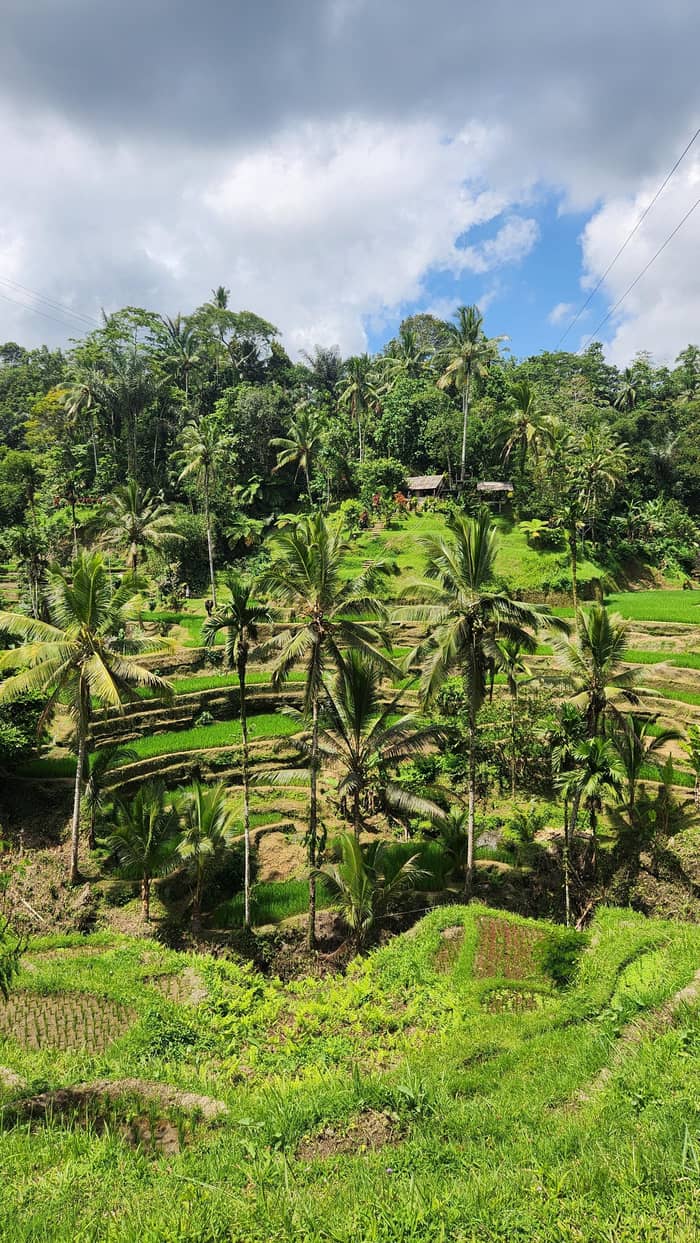
Longer private day
Private option offered
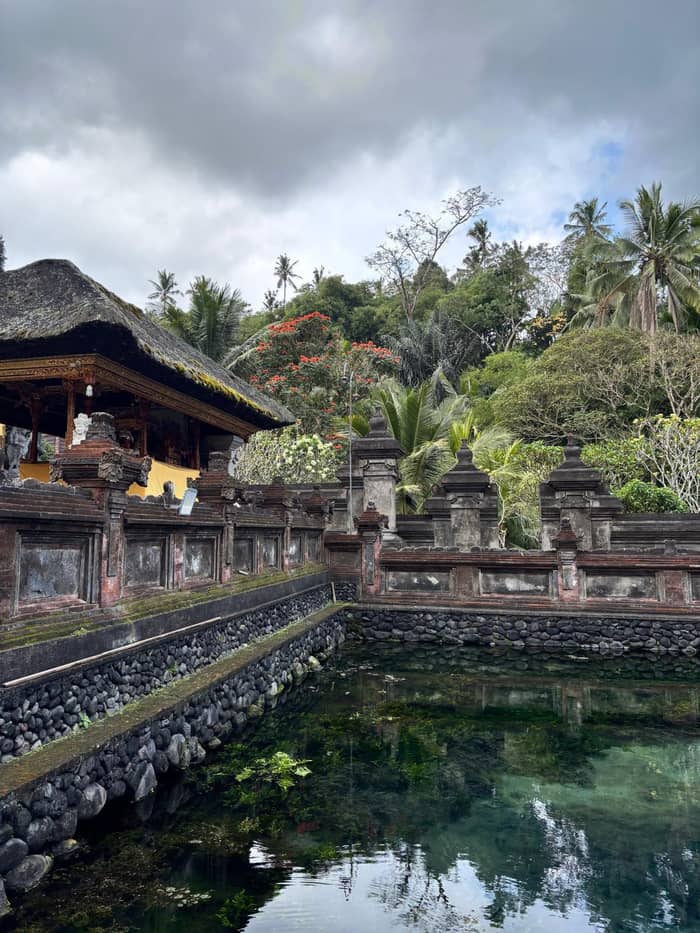
Shortest
Forest only
Start with the monkeys' side of the bargain. The sanctuary asks you not to touch them or try to pick them up, to keep a respectful distance, and not to feed or interact with them unless a trained staff member is supervising.22 Looking a monkey straight in the eyes may be read as a sign of aggression, so look at the tree beside it instead.21 These are not pets: the sanctuary calls them a large group of long-tailed macaques living in a semi-wild environment, not domesticated pets.45
Food is the usual trigger. Visitors may not carry food or drink into the forest, the monkeys may grab anything edible, and whatever you carry should stay zipped in your bags.5 The same page warns that small objects such as toys, jewellery, beads or anything resembling peanuts draw the animals, and that they should stay out of sight.46 Sunglasses on your head and a water bottle in a net pocket are the classic donations.
If a monkey jumps on you, the guidance is to stay calm and walk slowly; it will likely move on after a moment.47 The Indonesia.Travel guide to Ubud adds the same advice from outside: secure your belongings from the monkeys' reach.48 Finally, the sanctuary asks everyone not to bring plastic into the forest.49 Leave the carrier bag at the hotel and bring one small zipped bag. Keep your hands low and your bag closed, and let the animal lose interest by itself rather than waving it off.
The forest hour by hour
Opens 9:00 AM
The sanctuary lists 9:00 AM as opening time.1
Dance 11:00 AM
On Saturday and Sunday the open stage runs a performance at 11:00 AM.12
An hour or so
The site's day tour lists 60 minutes at the Sacred Monkey Forest.
Dance 4:00 PM
A second weekend performance starts at 4:00 PM on the open stage.12
Last entry 5:00 PM
Nobody is admitted after 5:00 PM, one hour before closing.1
Closes 6:00 PM
The sanctuary closes at 6:00 PM.1
Saturday and Sunday add a stage show. On its open stage the sanctuary puts on Balinese dance each Saturday and Sunday, at 11:00 AM and again at 4:00 PM.12 The culture page names the Lubdaka dance for Saturday and the Frog Dance, Tari Katak, for Sunday, each at 11 am and 4 pm.50,51,52 Build your visit around one of those slots if you want music with the monkeys. Arrive a little early to find a seat near the stage, and expect the paths to be livelier around those times than on a quiet weekday.
Feeding time is a quiet part of the day that visitors rarely plan for. Per the sanctuary the staple is sweet potato, handed out at least 9 times daily, and banana, papaya leaf, corn, cucumber, coconut and other local fruit join it each day.53 The animals are fed on a schedule, and you have no reason to offer anything yourself. Peanuts are expressly out; the FAQ says feeding them is forbidden for the monkeys' health.54
The sanctuary also keeps facilities for the animals: an animal clinic sits alongside the first aid clinic, exhibition room and open stage.55 That list is worth reading before you decide how much time to give the place. It describes a managed reserve with infrastructure rather than a wild trail, and the managed feel is part of why a short, calm visit works well. Knowing that staff and clinics are on site is reassuring if a child gets a scratch or a monkey needs attention.
Video
NowGetThere Travel on YouTube · YouTube loads only after you press play.
Do not touch the monkeys or try to pick them up. Always keep a respectful distance
Packed for the macaques
Its page gives the opening hours as 9:00 AM until 6:00 PM, and no one is admitted after 5:00 PM.1 On the same page an adult ticket is IDR 130,000 and a child's is IDR 100,000.1 Those are the sanctuary's own figures in rupiah, and this page does not convert them. Check the lobby board on the day; fees can change. A morning arrival gives the cooler air, softer light and quieter paths that make the walk pleasant, and it leaves room for a second stop afterwards.
The lobby is where you buy the ticket, collect information and, if you wish, buy souvenirs; the sanctuary's page also mentions the Wenara cafe in the lobby, serving drinks, coffee and snacks.56 Build in time at the lobby on busy mornings. The ticket itself carries tips, and the listing for one guided tour asks visitors to read the tips on the entry ticket before going in. Keep the ticket handy, since it carries the same short list of dos and don'ts that the sanctuary prints on its website.
Humidity is another planning point. One guided-tour listing says the sanctuary can reach 97 percent humidity, so dress as comfortably as possible. Wear light fabric, shoes that grip a wet path, and keep a spare layer in your bag. The forest closes at 6:00 PM and the last entrance is at 5:00 PM, which leaves late arrivals a short window to walk through.1 Showers can sweep through the forest, so a light rain layer weighs less than the regret of being soaked on an hour-long walk. In short, the Monkey Forest, Ubud, is a ticketed sanctuary with posted hours and posted rules.
Tours give the forest an hour or a bit more. The site's own Viator day tour lists the Sacred Monkey Forest as its first stop at 60 minutes, followed by Tegalalang rice terrace and a jungle restaurant with a swing. A GetYourGuide full-day listing gives the sanctuary 75 minutes, and a guided ticket listing gives it 1 hour. An hour is a workable length for the walk, the temples from outside and a sit by the pond.
The forest also pairs naturally with the rest of Ubud on foot. Indonesia.Travel suggests exploring the Tegalalang rice fields early in the morning and then heading to the Monkey Forest.57 The other half of the central circuit, the palace, the art market and the Saraswati temple, is a short stroll from here, which the map lays out. The pairing works well because the forest is shaded and the terraces are open, so one half of the morning cools you for the other.
If you book a day with a driver, ask for the forest at a quiet hour: opening time, or the last two hours of the day. The site's day tour is described as a private tour with a maximum group size of 15, and it costs from $59. If you only want the forest, a ticket and guided-walk listing starts from $16. The comparison cards below set the options out. Tell your driver the hour you prefer and ask them to plan around it.
FAQ
Doors open at 9:00 AM and shut at 6:00 PM; nobody is let in after 5:00 PM.1
A child's ticket is IDR 100,000 against IDR 130,000 for an adult, per the sanctuary.1
The sanctuary prohibits food and drinks inside, and monkeys may grab anything edible.5
The sanctuary says the temples are only for prayer in the Balinese traditional way.4
The sanctuary says not to panic or run; the monkey will likely move on after a moment.47
Balinese dance performances run at 11:00 AM and 4:00 PM on both days at the open stage.12
Sources
Keep reading
Questions about the Ubud day route? Ask a person here.