Our own full day
The full Ubud day
Terrace is stop 2 of 7
- Time at terrace45 minutes there
- Pricefrom $59
- Rating4.98
Locate the spot
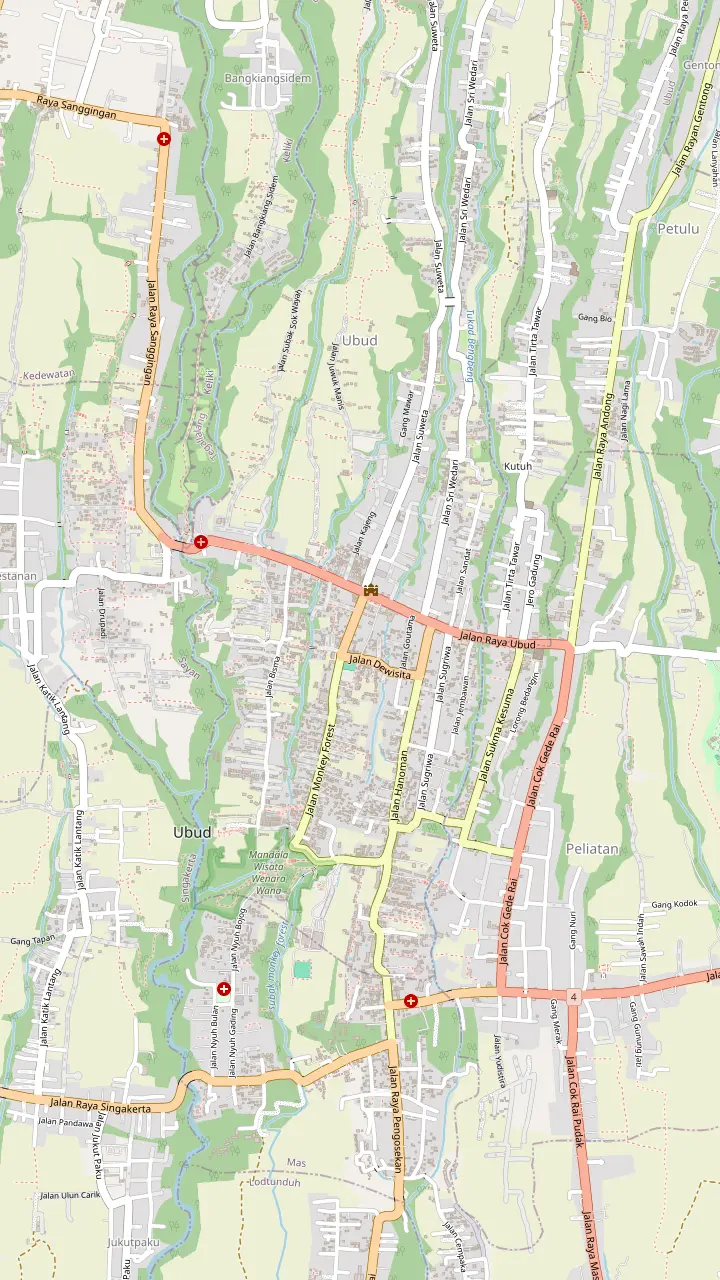
Show all 17 Ubud stops on the map
Choose a map view, then press a pin or a place name for its note and a Google Maps link.
Open 9:00 AM to 6:00 PM, last entrance 5:00 PM, with an adult fee of IDR 130,000.
Google MapsThe official residence of the Ubud royal family, where traditional dance is often held in the courtyard at night.
Google MapsSells Balinese souvenirs, handicrafts, jewelry and clothing, and prices are often negotiable.
Google MapsKnown for the lotus pond at the front of the temple; listed as free, open 07.00 to 17.00 WITA.
Google MapsCalled the oldest art museum in Bali, established in 1956.
Google MapsA free path open 24 hours, about 15 to 20 minutes to the peak over 2 kilometers.
Google MapsA palace founded in the 17th century that often hosts Legong and gamelan.
Google Maps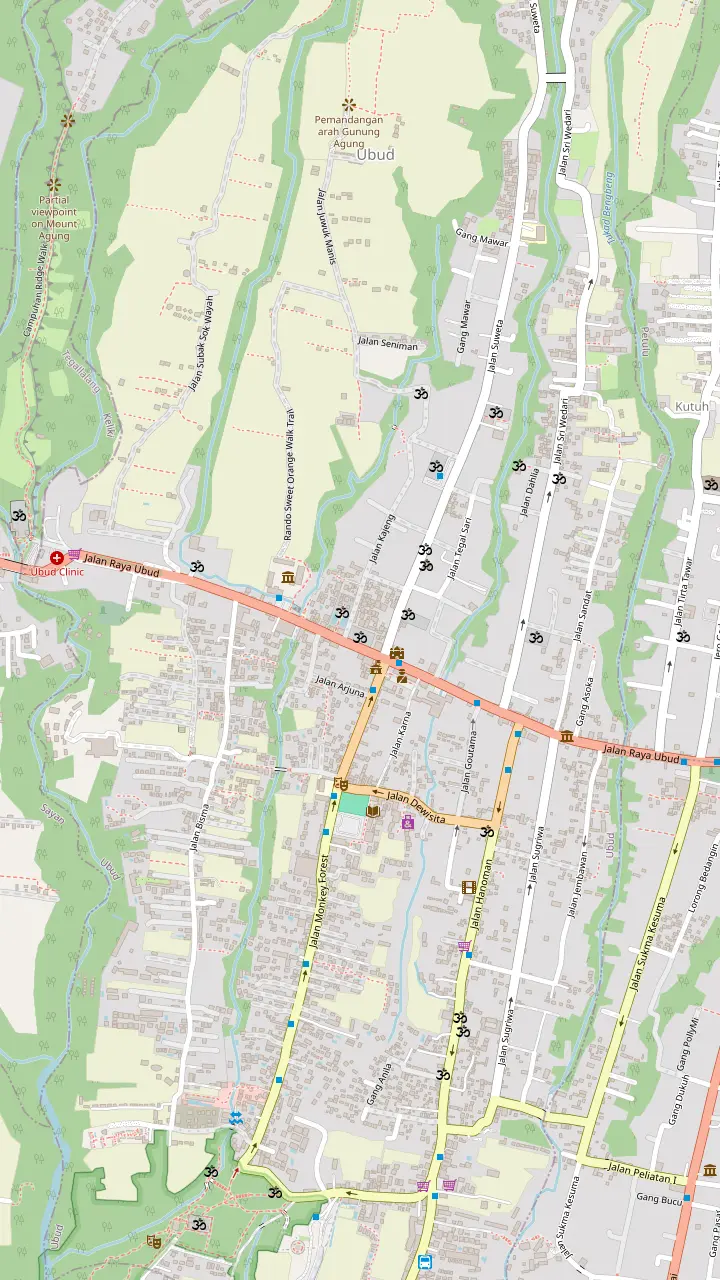
The Legong ticket listing gives 7:30 PM daily and about 90 minutes, and advises arriving 45 minutes early.
Google MapsThe ministry's palace page puts the evening admission at approximately Rp100,000 for the performances.
Google MapsIndonesia.Travel lists it on Jalan Kajeng in central Ubud.
Google MapsFounded by the King of Ubud with Rudolf Bonnet and Walter Spies to keep Balinese art from being sold abroad.
Google Maps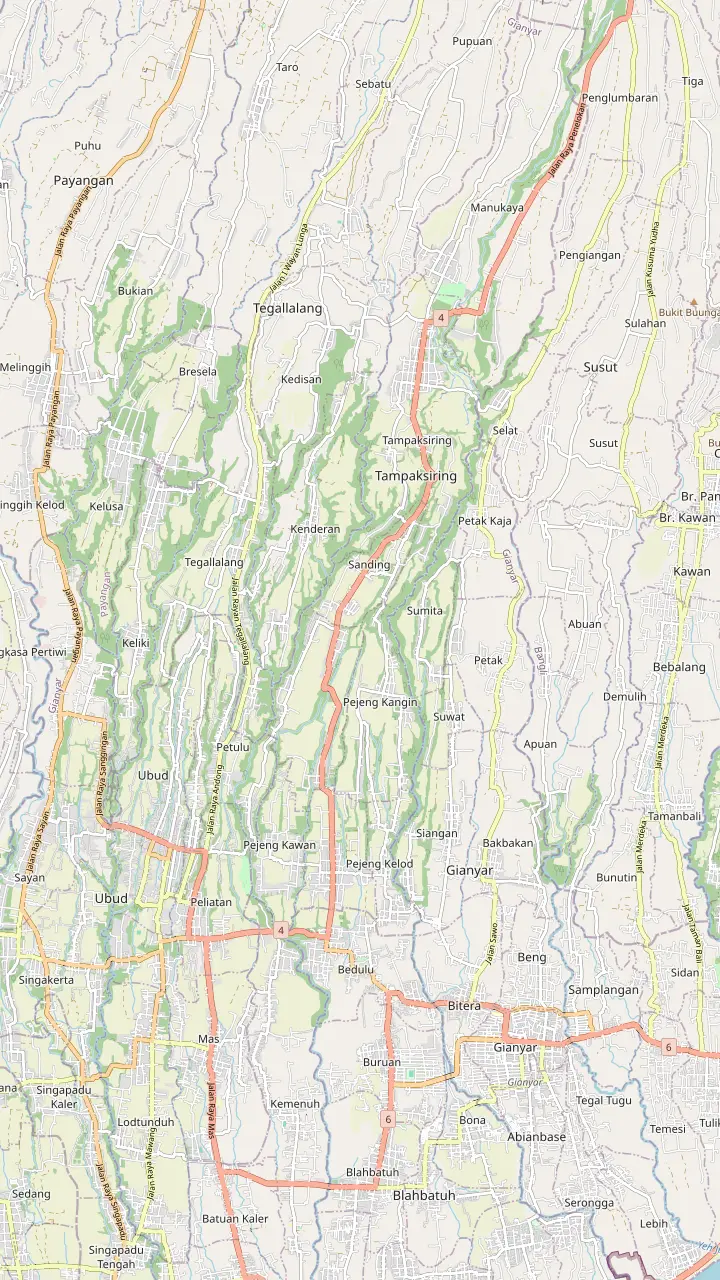
The terraces are a short 20-minute drive north of Ubud, or about two hours on foot.
Google MapsThousands of white herons return to the treetops every late afternoon; the village is open 06.00 to 19.00.
Google MapsExploring the terraces takes roughly 30 minutes to 1.5 hours.
Google MapsTo join the bathing ritual, wear traditional attire or a yellow sash and use no soap or shampoo.
Google MapsFour distinct complexes; a sarong and sash are essential and can be rented on site.
Google MapsA 15 meter waterfall the community considers sacred, used as a beji for holy-water ceremonies.
Google MapsMap drawn from OpenStreetMap data, © its contributors
Tegallalang Rice Terrace is the green staircase north of Ubud that tour itineraries call a photo stop. Here is how far it is, how long people give it and what to carry.
Editorial team, ubuddaytour.quest · Updated November 3, 2026 · Reading time: about 8 minutes
The short version of the day
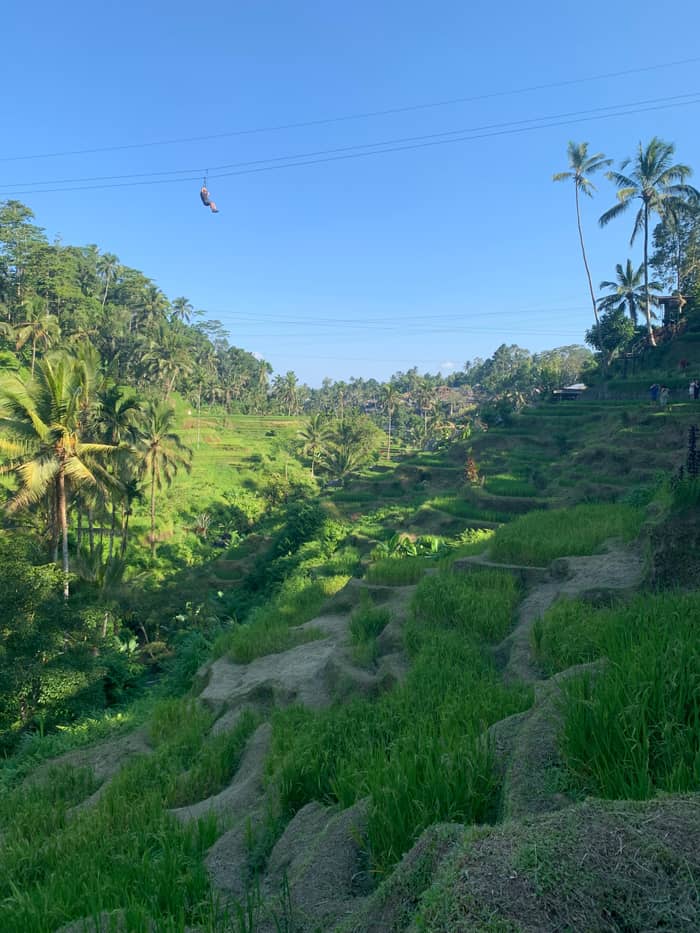
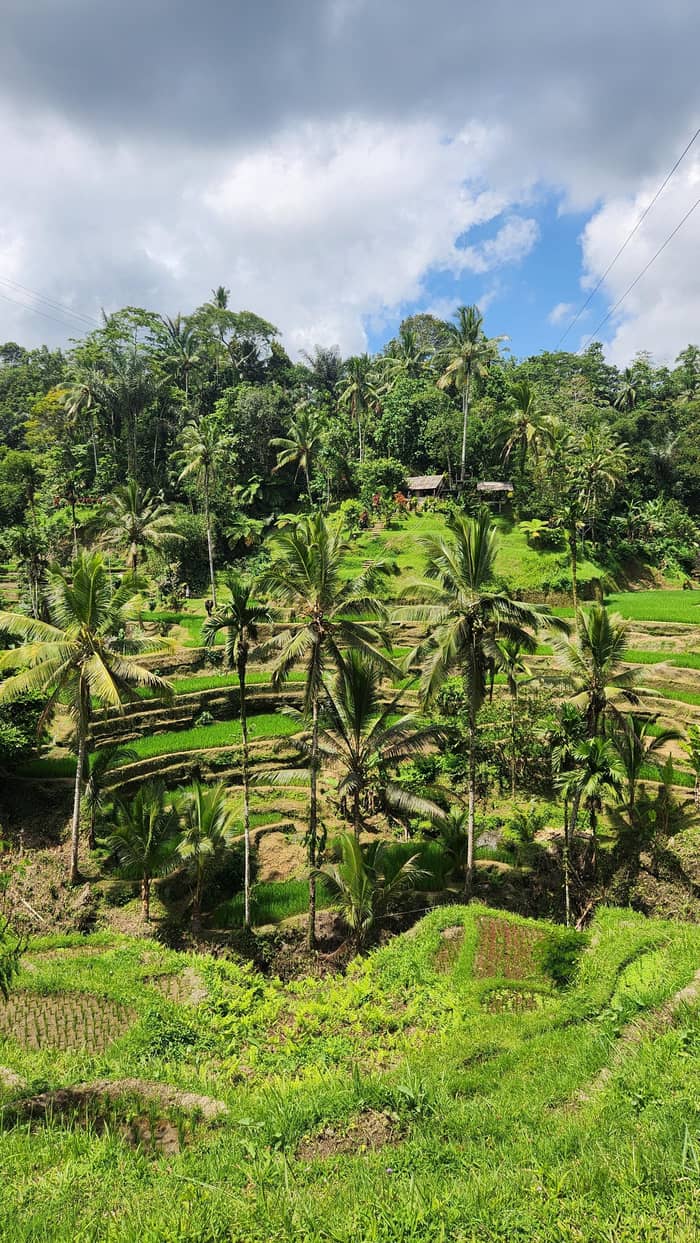
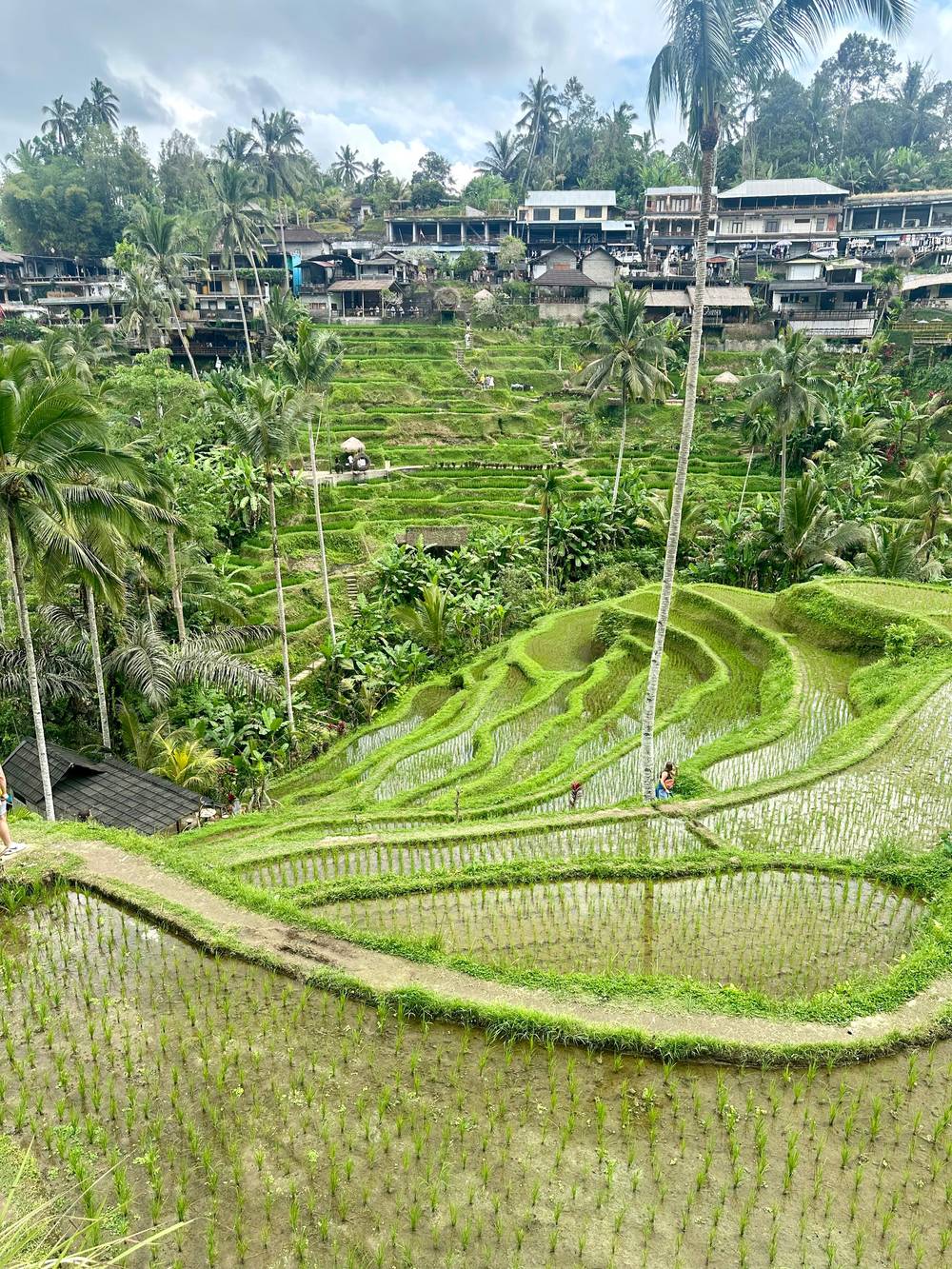
Indonesia.Travel describes Tegallalang Rice Fields as sitting in a valley that offers extraordinarily scenic lookouts over the terraces and the surrounding green landscape.6 That sentence is accurate in practice: the road runs along the lip of the valley, and the terraces fall away below it in curved steps. You do not need to hike to see them, but the view improves the moment you step off the road onto a path.
The ministry also ranks the place. It says Tegallalang forms, with the terraces of Pejeng and Campuhan, the three most stunning-looking terraced landscapes in the Ubud region.7 That grouping is useful for planning: if the crowd at Tegallalang is too much, Campuhan is a walk from central Ubud, and the guide treats it as a sibling rather than a lesser option. The rice itself changes color with the season, from wet glitter to bright green to gold.
Behind the picture sits a system. The terraces follow subak, the traditional Balinese irrigation system, which in the ministry's telling a sage called Rsi Markandeya handed down in the 8th century.8 A farmer working the lowest step is part of a shared water schedule, not a prop. Keep that in mind when the path takes you between plots, and stay on the walkways rather than the dikes that hold the water.
Getting to the green
| How | Time | Ministry's wording |
|---|---|---|
| A car and driver just for your Ubud group | A 20-minute drive | A short drive north of Ubud |
| Own motorcycle | Time not stated | Named as an easy way to reach it |
| Taxi | Time not stated | Another way to get there |
| Walking | 2 hours on foot | For those who prefer walking |
The 20-minute drive and the two-hour walk are Indonesia.Travel's figures for getting there from Ubud.1
The ministry puts Tegalalang Rice Terrace at a short 20-minute drive north of Ubud, and says those who prefer walking can take a two-hour journey on foot.1 It lists your own rented car or motorcycle as the easy option and a taxi as another way, each with a different experience.1 Pick by the day you have: a walk fills the morning, a drive leaves time for the rest of the north. Whichever you choose, set out before the heat and keep the return leg in mind, because the climb back up the steps is the part most people underestimate. A trip to Tegallalang Rice Terrace in Ubud's district therefore begins with a short drive, not a long expedition.
Driving north from Ubud is the common choice because the terraces sit on the way to other stops. The site's day tour lists the terrace as the second stop, after 60 minutes at the monkey forest, and before the jungle restaurant and the Tirta Empul spring temple. That order puts the terrace early, while the light is still gentle and the lookouts are not yet full. A driver can wait at the roadside while you walk, which saves you from hunting for parking at the edge of the valley.
If you are staying in Ubud and want a short half day, a GetYourGuide half-day listing combines the Sacred Monkey Forest for 1 hour, Tegalalang for 30 minutes and Kumulilir for 1 hour, with private groups available. The drive between each stop is part of the listed time. Build a buffer for traffic, since that listing itself warns that Ubud's traffic can be heavy at peak hours. That makes it a sensible option if you want the monkeys, the terraces and a swing without giving up the whole day.
Minutes on the staircase
Times are the stop lengths listed by each tour; the half-day tour's 30 minutes is for Tegalalang.
Indonesia.Travel says you need approximately 30 minutes to 1.5 hours to explore every corner of the area.2 The range is wide because the place can be a lookout or a walk. A photo stop at the top fits 30 minutes; crossing the small stream to the fields on the other side and climbing back stretches toward the upper end.2 Treat the wide range as a menu: a photo stop at the top, an hour for the walk down, or a slower morning with coffee afterwards.
Tours sit inside that range. The site's day tour lists 45 minutes at the terrace, one GetYourGuide private listing gives Tegallalang Rice Terrace 1 hour, and a full-day group listing gives the rice terrace 75 minutes. A half-day listing gives only 30 minutes. The chart below sets the four numbers side by side. The numbers show that the same place can be a short pause or a long stop, depending on how the itinerary around it is built.
Choose your length by what you want to do. A 30-minute stop suits a quick photo and a look from the top. An hour allows the descent, the stream crossing and a stop for water. A full morning suits those who want to walk the terraces slowly, drink coffee nearby and see the valley change as the sun climbs. Nothing here rewards rushing, and nothing forces you to stay. Nothing here rewards rushing, and nothing forces you to stay beyond what the day allows, so decide before you leave the car.
Shaping your terrace visit
Pick the pace that fits your day, then the tour or the drive that matches it.
If I want the quiet lookouts
Go early, before the tours
The ministry suggests exploring early in the morning.3
If I want a quick photo
A 30-minute stop
The half-day tour gives Tegalalang 30 minutes.
If I want to walk down and across
Give it an hour and more
Exploring takes 30 minutes to 1.5 hours.2
If I want coffee after the terraces
Bali Pulina, 1.3 km away
It shows how Luwak coffee is made and ends with tasting.9
If I would rather walk it
Walk from Ubud
On foot it takes about 2 hours, as Indonesia.Travel puts it.1
Three tours, three lengths
Our own full day
Terrace is stop 2 of 7
Shortest stop
Forest, terrace, Kumulilir
Time-rich option
Longest terrace stop
The ministry recommends a simple move: go to the Tegalalang rice fields first thing, then make your way to the Monkey Forest.3 That is the closest the official pages come to a sunrise tip, and it is worth taking literally. Early light is softer on the terraces, the air is cooler for the climb back up, and the lookouts have room. If your driver is flexible, aim to be on the terraces before the first tour groups pull up along the road. That is the case for the Tegallalang Rice Terrace at sunrise: you meet the valley while the light is young.
The ministry's terrace page adds practical advice that matters more later in the day: bring water and put on sunscreen.4 The slope is open, with little shade, and a late-morning walk down the steps is a different effort from the same walk at 8 AM. If your hotel offers breakfast before a driver's pick-up, eat a light one and leave early. Bring a refillable bottle, wear a hat and keep a small towel in the bag for the damp air at the bottom of the valley.
A day tour will not always let you choose. The site's 10-hour tour lists the terrace as the second stop, which sets its timing for you. If early light matters most to you, ask your driver to start at the terrace rather than the forest, then take the Monkey Forest afterwards. Say so when you book, so that the plan is clear in advance. Say so when you book, so that the plan is clear in advance, and confirm the order of stops again the evening before.
A morning on the terraces
Set off at dawn
Indonesia.Travel suggests exploring the fields in the early light.3
A 20-minute drive
The terraces are a short 20-minute drive north of Ubud.1
Up at the lookout
The viewpoints overlook the terraces and the surrounding green landscape.6
Upper end of the visit
Exploring takes 30 minutes to 1.5 hours.2
Once you are back up
Bali Pulina is about 1.3 km from the terraces.9
On tour
The site's 10-hour tour lists 45 minutes at the terrace.
The ministry singles out one swing, the one with the LOVE BALI sign at the entrance of the rice fields, and recommends carrying some cash because local children guard the sign.5 It also names Aloha Ubud Swing, on Jalan Raya Tegallalang in the same area as Alas Harum, which offers swing packages and views of rice terraces and butterfly gardens.26 A separate page on this site covers the Bali jungle swing in depth.
For coffee, the ministry names the Bali Pulina plantation, about 1.3 km from Tegallalang Rice Terrace, where visitors learn how traditional Luwak coffee is made, walk through the plantation with a guide and then taste it.9 A GetYourGuide full-day listing instead stops at the Segara Windhu coffee plantation for 75 minutes, so coffee is a standard part of the northern circuit. Coffee tasting is a good way to turn the stop into a break, and it gives you a seat out of the sun before the next leg.
Further north the circuit continues to the holy spring at Tirta Empul, where the ministry says visitors who join the bathing ritual wear traditional attire or a yellow sash and do not use soap or shampoo.23 Treat Tegallalang as the opening scene of that northern day rather than the entire day. If you leave the terrace with an hour in hand, the coffee stop is the easiest next step.
Video
Travellingwithmaz on YouTube · YouTube loads only after you press play.
situated in a valley that offers extraordinarily scenic lookouts over the terraces and surrounding green landscape
Packed for the staircase
You will see Tegallalang described as a World Heritage site. Indonesia.Travel's terrace page says that since the place has been listed as a UNESCO World Heritage site it has gained popularity among international travelers.27 It is the official ministry's wording, and many sites repeat it. The same page ties the terraces to the subak irrigation system.8 Read the sentence as the ministry's description, and read the UNESCO page for the property's own list of areas.
That wording is a good reason to check the official UNESCO page for the Bali subak landscape yourself, which names the component areas of the listed property, before repeating it in your own notes. Whatever the answer, the practical advice does not change: the terraces are a working agricultural landscape, and visitors are guests on someone's farmland. Visiting well is the same either way: walk lightly, ask first and leave nothing behind.
Responsible visiting is simple. Stay on paths, avoid stepping on young rice, ask before photographing farmers at work and keep your voice low. The ministry's own closing advice on the page is to be a responsible traveler and respect the locals and their beliefs.27 If you buy from a stall or pay a child at the swing sign, small rupiah notes make the exchange easy. These small habits are the real entry fee to a landscape that feeds the families who live beside it.
FAQ
Indonesia.Travel calls it a short 20-minute drive north of Ubud, or about two hours on foot.1
Indonesia.Travel says that is the time to explore every corner of the area.2
Indonesia.Travel suggests exploring the terraces early in the morning and the Monkey Forest afterward.3
Four listings give 30, 45, 60 and 75 minutes at the terrace.
Indonesia.Travel recommends cash because local children guard the sign.5
The plantation shows how traditional Luwak coffee is made, then ends with tasting.9
The ministry advises bringing water and putting on sunscreen at the terraces.4
Sources
Keep reading
Questions about the Ubud day route? Ask a person here.